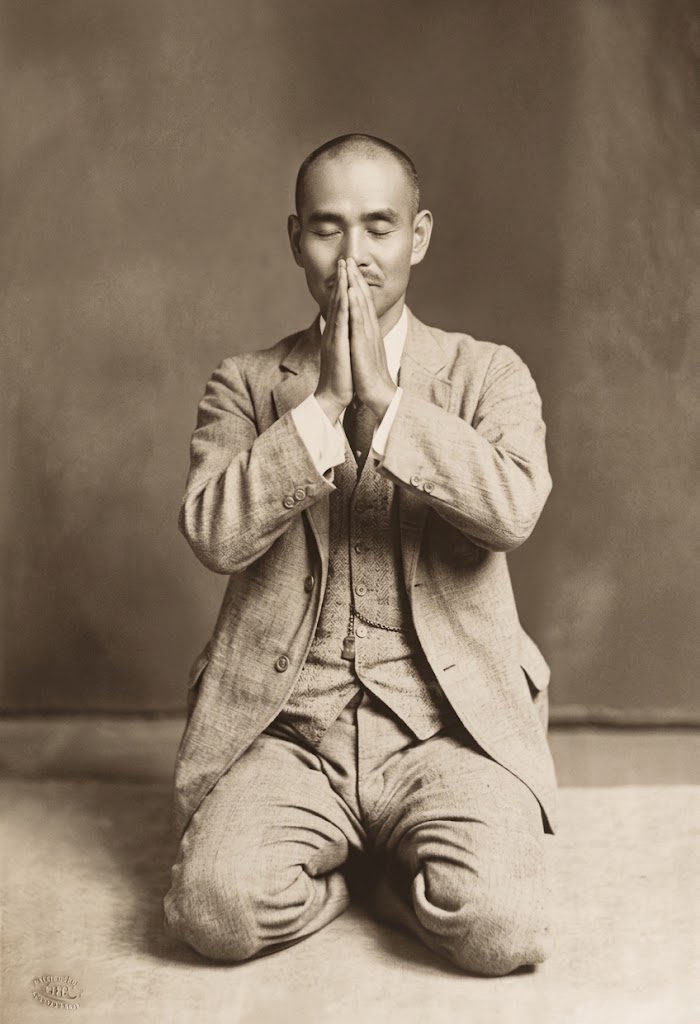
When studying the history of Japanese Reiki, much of the attention tends to focus on Mikao Usui, Chujiro Hayashi, and, later, Hawayo Takata. However, other traditions emerged directly from Usui's circle, allowing us to explore how those teachings were understood, transformed, and developed in Japan over the following decades.
One of the most interesting is that of Toshihiro Eguchi (江口俊博, 1873–1946), a Japanese educator who became acquainted with Usui Reiki Therapy and subsequently developed his own method, known as Palm Healing Therapy — 手のひら療治 (Te no Hira Ryōji).
His development can be reconstructed in remarkable detail because we have publications corresponding to different stages of his life and work: 1929, 1930, 1936/1938, and 1954.
Read together, these works are not simply four versions of the same teaching. They represent four distinct moments in a historical journey.
From Mikao Usui to Palm Healing Therapy: 1925–1927
To understand Eguchi's publications, we must begin several years earlier.
In 1925, at the age of 53, Eguchi was initiated into Usui Reiki Therapy (臼井靈氣療法) at the suggestion of Mrs. Tamura. This episode was later recorded among his posthumous writings.
According to his autobiographical account, Eguchi paid an initiation fee of 50 yen, as well as a separate fee for each meeting. Although he recognized the value of the practice, he began questioning why such a substantial amount of money should be charged for access to it.
The following year, in March 1926, Mikao Usui passed away.
In 1927, a turning point occurred.
Eguchi recounts that, after continuing his research and practice, he came to regard Usui Reiki Therapy as a natural healing ability inherent in human beings. For precisely this reason, he questioned whether large sums of money should be charged to transmit it.
This was not merely a matter of personal reflection.
Eguchi discussed the issue with his uncle, Shinshiro Eguchi, and eventually decided to become independent. He submitted his resignation to the association and gave a new name to the method he would begin teaching publicly:
手のひら療治 — Te no Hira Ryōji — Palm Healing Therapy.
According to his own account, the response was immediate. Interest grew to the point that his home could no longer accommodate everyone. Eguchi then rented the second floor of Onsen Taki, opposite Kōfu Station, and began receiving between one hundred and one hundred and fifty people per month.
Therefore, when we encounter the first major publication devoted to Palm Healing Therapy in 1929, we are not witnessing the sudden appearance of a new method.
There is a documented historical sequence:
1925: Usui Reiki.
1926: The death of Mikao Usui.
1927: Eguchi's independence and the emergence of Te no Hira Ryōji.
1929: The first major written and public presentation of the new movement.
And this is precisely where the publishing history we can reconstruct begins.
1929 — The Public Presentation of Palm Healing Therapy
On June 20, 1929, the Japanese magazine 『日本及日本人』 (Nihon oyobi Nihonjin, "Japan and the Japanese") published a special issue devoted to Palm Healing Therapy.
The material was compiled by Mitsui Kōshi (三井甲之).
This document is particularly valuable because it is not yet a manual written retrospectively after years of expansion. Instead, it allows us to observe the movement at a very early stage.
There is another fundamental difference between this publication and the later books: it does not present a single voice.
Its pages contain writings by Takiguchi, Ōtsuka Hideo, Mitsui Kōshi, Toshihiro Eguchi, Tashiro Jun'ichi, Miyazaki Gorō, and Kondō Hiroshi, among other contributors.
This makes the 1929 publication something like a documentary snapshot of the movement while it was still taking shape.
One of the most interesting testimonies is that of Takiguchi, who recounts having received the transmission in 1928.
He describes arriving at Eguchi's home, finding more than twenty people present, practicing with closed eyes and palms joined in gasshō, undergoing the transmission procedure, and subsequently experiencing sensations in his own hand.
Regardless of how we interpret these therapeutic claims today, their historical value is considerable: we are reading the testimony of someone describing how new practitioners were introduced to Eguchi's method just one year after his independence.
The publication also preserves writings by Eguchi himself, explanations by Mitsui, practitioners' experiences, accounts of therapeutic applications, waka poems, and reflections on the social significance of making a simple practice available for use within the family.
For this reason, the 1929 document should not be understood merely as a primitive version of the book that would appear the following year.
Its value is different.
It allows us to observe the public emergence of a movement.
1930 — The Systematization: 『手のひら療治入門』
One year later, a much more organized work appeared:
『手のひら療治入門』
Te no Hira Ryōji Nyūmon
Introduction to Palm Healing Therapy.
Once again, we find the fundamental involvement of Mitsui Kōshi, who compiled and organized the teachings associated with Eguchi and his method.
Eguchi himself would later recall the importance of this publication.
According to his autobiographical account, the book reached approximately twelve or thirteen thousand copies, and its circulation led to numerous letters and inquiries arriving daily from different places.
Between April and June 1930, practical training meetings were also held in Tokyo. According to Eguchi's testimony, between three hundred and five hundred people joined these gatherings.
If 1929 shows us the movement as it began to enter the public sphere, 1930 represents an effort to explain and organize the system for a much wider audience.
Here we find fundamental questions explored in greater depth: what Palm Healing Therapy was, why it was considered accessible to everyone, how it should be learned, the role of gasshō, how the hands were applied, and how practitioners understood the nature of this ability.
Naturally, some material from 1929 reappears.
But this does not necessarily represent a documentary weakness.
On the contrary, comparing the two publications allows us to observe which elements of the early movement were preserved, which were expanded, and which began to acquire a more stable formulation.
1929 records the public emergence of the movement.
1930 begins to transform it into a system that could be transmitted through a book.
1936 — The Maturity of the Method: 『手のひら療治讀本』
Six years later, we encounter a different work:
『手のひら療治讀本』
Te no Hira Ryōji Dokuhon
Palm Healing Therapy Manual.
The first edition appeared on January 10, 1936, with a print run of 2,000 copies. A revised second edition was published on June 15, 1938, also with a print run of 2,000 copies.
The work is associated with Toshihiro Eguchi and Nemoto Seiroku (根本清六) and gives us access to a considerably more mature stage of the movement.
By then, approximately nine years had passed since Eguchi's independence.
It was no longer simply a matter of explaining what Palm Healing Therapy was.
We find a much more developed world of practice: meetings in the dōjō, gasshō, recitation of imperial poems, Ōzora Gasshō, Yogoto, Norito, reflections on kotodama, specific instructions on how to apply the hands, questions and answers from practitioners, and discussions about diet.
Another dimension also becomes particularly clear, one that is especially important for understanding Eguchi: Palm Healing Therapy was not conceived merely as a technique applied to someone who was ill.
In these writings, it is connected with the practitioner's inner attitude, humility, relationships between people, family life, and a particular ethical and spiritual outlook.
One sentence from the manual expresses this in an extraordinarily simple way:
"Nothing brings people closer together than the act of laying on hands."
Another passage states:
"Mental concentration or the attainment of a state of emptiness is not required; a sincere and humble heart is enough."
We also find a statement that prevents us from reducing Eguchi's method to an absolute rejection of medicine:
"But doctors are indeed necessary."
These statements acquire even greater significance when compared with the earlier publications.
What was beginning to emerge publicly in 1929 had, by 1936, developed into an organized practice with meeting places, rituals, teaching methods, terminology, and an established community of practitioners.
1954 — After Eguchi: 『手のひら療治を語る』
Toshihiro Eguchi died in June 1946, while living as an evacuee in Odawara.
But the documentary history of his method did not end with him.
Eight years later, the following work appeared:
『手のひら療治を語る』
Te no Hira Ryōji o Kataru
Talking About Palm Healing Therapy
with the subtitle:
『江口俊博遺稿集』
Eguchi Toshihiro Ikōshū
Collection of Posthumous Writings by Toshihiro Eguchi.
Here, we must make an important distinction from the earlier publications.
This was not a new book written by Eguchi in 1954.
It was a posthumous work.
And we can identify a central figure behind its publication: Setsuo Nakakura (中倉節男).
Nakakura had received direct guidance from Eguchi and stated that he had helped people suffering from illness for more than twenty years by following his teachings.
After his teacher's death, he wished to recover and spread that path once again.
The first, third, and seventh anniversaries of Eguchi's death passed before Nakakura finally managed to gather his writings and prepare them for publication.
His editorial remarks are dated December 1953.
The book appeared the following year.
The foreword was also written by Nishida Tenkō, founder of Ittōen and a figure closely associated with Eguchi. Nishida explains that Nakakura decided to use donated funds to make the publication possible, with the aim of honoring his teacher's memory and spreading his teachings once again.
The result is a document fundamentally different from the three earlier works.
Its pages contain Eguchi's writings, recollections, autobiographical materials, testimonies, and the perspectives of those who knew him.
And it is precisely thanks to this publication that we can reconstruct part of the journey that began in 1925.
Here we find documented his introduction to Usui Reiki, his subsequent doubts, his independence in 1927, and the development of Palm Healing Therapy.
For this reason, 1954 should not be interpreted as a new technical stage in the development of the method.
It represents something else: the construction and preservation of Eguchi's memory after his death.
Four Publications, Four Different Historical Moments
When these works are placed side by side, a development emerges that is difficult to appreciate when reading only one of them.
YearPublicationWhat It Allows Us to Observe1929Special issue of Nihon oyobi NihonjinThe movement's early public presentation and the voices of its first practitioners.1930Te no Hira Ryōji NyūmonThe organization and systematization of the teachings.1936/1938Te no Hira Ryōji DokuhonThe mature practice: dōjō, rituals, teaching, application of the hands, and its social dimension.1954Te no Hira Ryōji o Kataru — Eguchi Toshihiro IkōshūEguchi's legacy, his posthumous writings, and the reconstruction of his life and work.This also explains why certain subjects appear repeatedly.
We are not dealing with four different systems.
We are observing the same movement at different historical moments.
An idea presented in 1929 may reappear in a more developed form in 1930 and emerge again years later within a much more elaborate framework of practice.
That continuity is precisely one of the most interesting features of this body of historical material.
What Changed From the Reiki Eguchi Encountered in 1925?
This is probably one of the most interesting questions that these sources allow us to begin investigating.
We know, from the autobiographical account preserved after his death, that Eguchi became acquainted with Usui Reiki Therapy in 1925.
We also know that in 1927, he decided to become independent and name his system Te no Hira Ryōji.
However, it would be a mistake to automatically assume that everything appearing in his later books was taught to him directly by Mikao Usui.
The historical sources do not support such a conclusion.
And that is precisely why they are so important.
They allow us to investigate which elements Eguchi preserved, which he reinterpreted, and which he incorporated during the subsequent development of his own path.
When we encounter references in his publications to gasshō, imperial poems, kotodama, diet, collective practices, dōjō rituals, or particular explanations concerning the application of the hands, we must ask ourselves:
What belonged to Eguchi's earlier experience? What came from his contact with Usui Reiki? What did he develop later? What contributions were made by Mitsui, Nemoto, and other members of the movement?
We do not always have a definitive answer.
And recognizing those limits is just as important as recovering the documents themselves.
Why Recover These Historical Sources?
Today, it is easy to look back at Reiki history as though there had been a single, uninterrupted lineage from Mikao Usui to the present day.
Contemporary Japanese documents reveal a considerably more complex reality.
After Usui's death, individuals emerged who continued researching, teaching, and developing their own approaches.
Toshihiro Eguchi was one of them.
His historical importance lies precisely in the fact that he left behind a body of documentary evidence that allows us to follow part of this process almost chronologically.
1925: Eguchi encounters Usui Reiki Therapy.
1926: Mikao Usui dies.
1927: Eguchi becomes independent and establishes Palm Healing Therapy.
1929: The movement receives a major written public presentation.
1930: The teachings are systematized and reach a much wider audience.
1936–1938: We find a mature system, with established practices, meetings, and a developed community.
1946: Toshihiro Eguchi dies.
1953: Setsuo Nakakura gathers and prepares Eguchi's writings.
1954: His posthumous collection is published.
These represent almost thirty years of history that can be studied through documentary evidence.
And many questions remain unanswered.
That is why recovering these works is not simply a matter of translating old books.
It means attempting to reconstruct, document by document, a part of the Japanese history of Reiki and hands-on healing practices that remained largely inaccessible for decades to those unable to consult the original sources.
Historical Japanese Reiki Sources — Terapia Bioenergética
At Terapia Bioenergética, we continue working on locating, digitizing, transcribing, translating, and studying these historical Japanese sources.
If you are interested in following our research, historical documents, and new translations, you can find us here:
Facebook: Terapia Bioenergética Argentina
Instagram: @terapiabioenergeticaarg
TikTok: @terapia.bioenergetica
Website and historical research articles: www.terapiabioenergetica.com.ar